Culminating Views on Assessment

Sunday, September 17, 2023 No comments

*The following post is an assignment for my doctoral class on assessments.*

Definition of Assessment

Stiggins (2018) defines assessments as collecting evidence of student work to make informed “educational decisions” for students. While this definition is close to my own personal definition, I would replace “educational” with “instructional.” In my current role as an assistant principal of a 6-8 grade middle school, I have learned that the term “instruction” is more personal for teachers. Administering well-planned assessments can provide the teacher with data to make the best instructional decisions for students in order to maximize learning, growth, and achievement.

Student assessments are not the only educational assessments, though. Teacher effectiveness is assessed through several observations throughout the year that are rated on an evaluation rubric. While most districts include areas of professionalism and contributions to school culture in the evaluation process, planning and instruction are weighted most heavily on teacher evaluations because those areas have direct, significant impact on student learning.

Assessments are not limited to individual people. Indiana schools are assigned a letter grade each fall based on student results on state standardized tests, as well as overall student attendance, from the previous school year. Utilizing an A-F system, schools are assigned a grade, which some argue does not fully represent a school, since the grade is based on achievement and does not take into account growth.

Preferred Type of Assessment

“Recent research suggests that both principals and teachers find many types of assessments useful. Yet, while more than 90 percent of teachers say they use data to adjust instructional strategies,nearly 30 percent did not feel prepared to interpret results” (Jackson et al., 2017). This suggests that educators need more experience in building assessment literacy in order to better prepare students and move them to proficiency of standards. Using assessment data to make classroom instructional decisions can be powerful.

My own personal preference for assessment is a combination of multiple choice questions and constructed responses for a formal assessment. Utilizing Google Forms to build these assessments allows data to be collected and analyzed quickly, assessments to be housed to make quick revisions each year, and students are familiar with Google Forms, so I do not need to worry about a new platform interfering with the reliability or validity of the assessment. For quick checks for understanding, nothing will ever take the place of pre-planned questions the teacher asks throughout a lesson that students answer on dry erase boards so that the teacher can immediately see what students understand the learning objective and who needs assistance.

Effort Grades

Stiggins (2008) states “we must implement classroom assessment practices that rely on an ongoing array of quality assessments used strategically in ways that keep students believing in themselves.” When assessments focus too heavily on mastery of standards and not enough on a student’s growth towards the mastery of standards, some struggling learners can feel lost or lose a sense of confidence in learning. Historically, educators have not been provided opportunities to learn sound assessment practices or focus has been on high-stakes assessments (Stiggins, 2008).

Effort-based grading focuses on the effort a student puts forth on work. Effort-based grading has benefits, such as students are more willing to take risks, students learn that the effort put forth impacts their outcome, and because the focus is not necessarily a grade, effort-based grading allows the instructor to focus on feedback that promotes student growth (Sull, 2022). Participation grading is when a student gets a grade for attempting the assignment, no matter the quality of effort put forth. Participation and effort grades are similar in that accuracy is not being assessed, but rather one’s attempt.

Effort and participation grades can impact student achievement. Participation and effort grades can provide the instructor opportunities to give clear, actionable feedback to students that push learning forward. Effort and participation grades also allow a student to attempt something and take risks without worrying about whether the attempt was “right” or “wrong”. Focusing too much on participation or effort can be detrimental, though. Focusing just on effort or participation does not show a student’s progress towards mastery of standards.

Student Self Assessment

Student self assessment can come in a variety of forms. It can be as simple as students placing exit tickets in bins labeled “I got it,” “I have some questions,”and “I’m confused.” It could be a reflection log. Or, it could even be something like this assignment, where we are reflecting on the major learning objectives from the modules. Zhang and Jackson (2022) states, “While the contribution information can be collected, the challenge is whether it is rigorous enough for evaluative purposes. In other words, can the ratings be trusted?”

Teachers across the country share the same concern in regards to student self assessments, especially whether or not students will actually use the assessment to reflect on learning, or as a manner in which to boost their grade. “Statistically, answering this question is equivalent to evaluating the reliability and validity of those ratings,” (Zhang & Jackson, 2022). With low stakes, I found that more students are willing to reflect honestly. In my experience, once a numerical score is part of the reflection process and is added to the gradebooks, students tend to rate themselves much higher in order to bring up their overall grade.

Student Growth Portfolios

As a former English/Language Arts teacher, I find portfolios to be an invaluable tool to showcase student learning and to highlight student growth. In my particular content area, student growth in writing is illustrated effectively through student writing portfolios. Paired with quick reflection assignments, educators, students, and parents can quickly evaluate how a student is moving towards mastery.

Unfortunately, in the past decade, standardized testing has taken more of a focus in middle school classrooms across the country. This has reduced time and focus on portfolios to emphasize student growth. “The intervening years have been sobering: the call for an opportunity to learn standards proved too politically charged, portfolios lost ground to more tractable standardized measures, and a focus on measuring achievement came to exclude much tougher and more fundamental discussions of how to promote and calibrate student growth. Ultimately, the curriculum narrowed to emphasize literacy and mathematics in schools serving less privileged and lower-achieving students who depended on their public schools for a chance to study the arts, science, and world languages,” (Palmer Wolf & Holochwost, 2017).

Figures in the Assessment Process

A comprehensive assessment system includes a multitude of assessments - formative and summative, low-stakes and high-stakes, academic and behavior, and accuracy and effort/participation. A balance of these types of assessments is needed in order to help student learning and to measure progress of learning. Helping students understand how they are being assessed creates self-efficacy which can lead to greater achievement.

Figures, tables, and assessments go hand-in-hand. Educators in schools utilize figures, tables, and charts every day to represent assessment data in order to use the data to make productive changes to assessments. Sometimes these figures are used to introduce new strategies or assessments that a professional learning community (PLC) would like to implement. For example, if a group of educators wanted to start incorporating Socratic Seminars in classrooms, they might highlight an example as seen in Figure 1.

Figure 1

Socratic Seminar Rubric


Behavior Assessments to Improve Instruction

There is this picture that floats around on the Facebook posts of teachers every year. It has the phrase “You have to Maslow before you can Bloom” meaning we have to take care of students' basic needs before they are ready to learn. When we don’t, there are often behavior issues that arise that impact academics.. The majority of students with emotional or behavior issues read below grade level (De La Cruz et al., 2019). “In addition, there is some evidence that students with problem behavior and reading problems in kindergarten are likely to demonstrate the least reading growth across time” (De La Cruz et al., 2019).

When I was in a classroom, those students who might exhibit off-task/disruptive behavior would be the first group I would pull. I would want to make sure that the directions given were clear, and I wanted to make sure they felt comfortable with the work, so that it might diminish the off-task/disruptive behaviors. I realized that when I didn’t pull that group first, the behaviors would start and then interrupt others.


References

De La Cruz, V. M., Otaiba, S. A., Hsiao, Y.-Y., Clemens, N. H., Jones, F. G., Rivas, B. K., Brewer, E. A., Hagan-Burke, S., & Simmons, L. E. (2019). The Prevalence and Stability of Challenging Behaviors and Concurrent Early Literacy Growth among Kindergartners at Reading Risk. Elementary School Journal, 120(2), 220–242. https://doi.org/10.1086/705785

Jackson, C., Gotwals, A. W., & Tarasawa, B. (2017). How to Implement Assessment Literacy. Principal Leadership, 17(9), 52–56

Palmer Wolf, D., & Holochwost, S. J. (2017). From the Middle: A Quarter Century Later. Voices from the Middle, 25(1), 27–29.

Stiggins,R.J.(2008)Assessment Manifesto: A Call for the Development of Balanced Assessment Systems. A position paper published by the ETS Assessment Training Institute, Portland, Oregon.

Stiggins, R. (2018). Better Assessments Require Better Assessment Literacy. Educational Leadership, 75(5), 18–19.

Sull, E. C. (2022). Labor-Based Grading: Perfect for Distance Learning! Distance Learning, 19(1), 59–62.

Zhang, B. & Jackson, L. (2022). Exploring the Utility of Peer and Self Assessments in Grading Group Projects for Urban Middle School Students. New Waves - Educational Research & Development, 25(2), 20–31.


Learning from Elsa: (Trying to) Let It Go

Tuesday, April 16, 2019 2 comments

     I'm a Type A person.  I like to-do lists.  I have to have my planner at all times.  (I was at a conference and a water bottle exploded in my bag.  It pretty much drenched my planner and I started to hyperventilate.  I couldn’t feel my limbs.  I think that’s what a stroke must feel like.) The cabinets in my classroom are organized with smaller containers that have labels on everything.  My circle likes to joke about my Type A-ness, but the truth of it is that it helps me survive the chaos of middle school. I wouldn't be able to do half of the things I do without that personality trait.  My Type A, perfectionist attitude almost got the better of me this week, though.  Almost.  And I'm so glad it didn't.

     Our school is having its first-ever door decorating contest.  Why first-ever?  Well, until Christmas, we were an open-concept school.  If you haven't experienced the challenges of a school without doors or full walls, imagine over 950 middle schoolers in some sort of large rat maze.  That was what we dealt with on the daily.  Our construction project to close in classrooms is finally finished!  This is the first time in maybe four decades that every teacher has a door!

     Anyway, so to pump up kids for state testing, each team was asked to decorate their door/hallway.  Our team was down to superheroes or Star Wars for a theme.  Fortunately, my son has had two Star Wars birthday parties and since Type A lady here saves all party decor because you never know when you might need it again, we went with Star Wars.

     First step was to cover the door with a black tablecloth.  I backed away so the kids could do it.  What I saw made me want to peel the skin away from my face.  It was crooked, it had holes in it, and it had more wrinkles than an English bulldog’s face.  I almost tore it off to redo it myself, but I didn't.  In my head and using my best Elsa voice, I repeatedly started singing, "Let it go!  Let it go!"  That's much easier said than done for Type A me, but I did nothing.  I had a few kids that wanted to stay after school to finish it.  They asked for a new tablecloth to try it again and I obliged.

Their finished product!
     What I saw was better than anything I could have done or imagined.  They figured out how to wrap the door like a present, so the background looked much better.  They used green plates and construction paper to make a Yoda head.  They found yarn to put together a banner for each teacher on the team.  This morning, they raided my cabinet for bulletin board letters to make a Yoda-like testing phrase.  They figured out how to tape a foam lightsaber to the door to get it to stick.  The only thing they needed me to do was to figure out how to get the hooks to not tear away from the tablecloth when they hung the robe (It was heavy!). Oh, and roll tape to hang things.  Apparently, that is a teacher-ninja skill.

     I could have stayed late last night to fix it myself, but I didn't.  Doing it myself would have robbed them of the pride they felt when they finished.  Watching them work together to figure it out was absolutely priceless.  They are so proud of themselves and the work they did.

     And Type A me is pretty proud of them, too.


     Love and Sparkle,


Remembering 9/11: A Middle School ELA Approach for September 11th

Sunday, September 9, 2018 4 comments


     Everyone can tell you where they were on September 11, 2001.  I was sitting in my high school French class, on my way to a Jimmy Buffet concert in Indianapolis that evening.  The first plane hit while we were in study hall and because everyone thought it was an accident, we didn't turn on the tvs until the second plane hit.    Then it became very real that this wasn't an accident at all.  We sat in French class absolutely mesmerized at what was happening.
    Three years ago when talking about this day with a group of seventh graders I realized these events were just stories to my kids, like learning about anything "in the past."  They knew about the day only through stories they've heard and historical fiction novels they've read.
     I guess to some I wasn't directly affected by the events on 9/11, but in a way, we all were, though.  I was seventeen and it was the first time I realized there was a world much larger than the world I experienced everyday. Because someone invaded that world in such a tragic way, I sat glued to the tv, soaking in very piece of information I could, just trying to understand what had happened and why.  I guess I felt like learning as much as I could might help me be more empathetic to those who lost loved ones.
     I suppose that's why I feel so passionate about making sure that my students understand what exactly is being remembered and honored.  My goal as a Language Arts teacher is to make my students more empathetic towards others, from any event, situation, or story.  This why I carefully structure my class on September 11th each year.
    First, I have students complete activities in this Hyperdoc, created by Katherine Baker.  Students have to think about what they already know about the events from 9/11, choose a few videos to watch, do a little research, and post their findings and reflections to a Padlet.  Starting with this activity gives every student some background knowledge. (Be sure to make a copy of the Hyperdoc and update with your own Padlet link before sharing with students.)
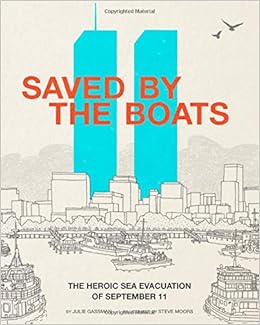
Image result for saved by the boats
The illustrations in the book are gorgeous.
    Next, we read a short picture book called Saved by the Boats, which tells the story of the several boats that heroically helped the people on Manhattan island return home after all other forms of transportation had been shut down.  I love this because it brings in a perspective that most students haven't heard of until now.  While I'm reading, I ask students to write down at least 10 facts mentioned the story. (We use this story for other things throughout the year, so this quick read sets up other lessons in the year.)
    Then, I put a picture from the day on the board.  This particular one seems to generate a lot of discussion.  I ask students to pick someone from the photo and write a from their perspective.  We do a quick mini-lesson review on mood and tone so that students know what emotions to convey, and what tone they need to have as the author.  Their one requirement is to include at least 5 facts from the book in their writing piece.  After 15 minutes of writing, I ask students to share.  (This year I want to try Barry Lane's Human Tableau, where the students come up and mimic the picture.  Then, I call out a person and they read their character's story.  He did it at a workshop this summer with a picture from the Holocaust and it was absolutely breathtaking.)
Image result for september 11 people
My students always point out the man going
 in the other direction.  It leads to lots of discussion
 on those who went back to help others.
      Finally, we end class with a close reading of the poem "The Names" by Billy Collins.  It leads to a really good discussion on the different ways we remember people, and I let the kids create a memorial for something or someone special to them.
     I've had two-hour classes for the past two years, so doing all of this in one period was very much possible.  I am back to a more traditional schedule (59 minute periods), so I plan on doing the first two activities on September 11th, and then completing the last two activities on September 12th.  That breakdown just makes sense for me.  I can easily see where you could go into depth with one of these activities and it could last whole period.  If you like any of these ideas, feel free to use them any way you wish.  Hope this helps give you an idea on how to make September 11th relevant and thoughtful for your middle schoolers.


Love and Sparkle,

5 Tips for Argument Writing: Guest Post on 2 Peas and a Dog

Wednesday, April 25, 2018 No comments
Be sure to head on over to 2 Peas and a Dog to check out my guest post on 5 Trips for Argument Writing!  It has my best how-to advice setting up an argumentative writing unit with middle schoolers.  For stopping by, here's a FREE sample unit I created about reality tv!  You can make a copy of it and make any changes you need.  Be sure to leave feedback below.  Thanks!
Create and teach an effective and engaging argument writing unit with these 5 tips from 2 Peas and a Dog. #argumentwriting #englishlanguagearts #lessonplans #middleschool #2peasandadog

Love and Sparkle,

Breakout of Boring Routines: How to Find and Use Digital Breakouts

Wednesday, March 14, 2018 No comments
     I was a skeptic.  There, I said it.  I was most definitely a skeptic when first introduced to Breakout games for the classroom.  We were in a summer leadership team meeting and our technology director brought the boxes for us to try.  I had so much fun, and I could see how they could be used to engage students in content or work on collaboration skills, but my mind went into teacher mode - my kids fight with each other like crazy or would lose or reset those locks!  So, another year went by before I started to think about them again.
     Then, I found a digital Breakout about plot structures.  (Actually, it might have been one of my teammates who found the digital breakout, but I'm not really sure.  My team and I spend a lot of time together - A LOT - to the point I'm not sure who had the original idea.  So, teammates, if you shared it, thanks for it and the blogpost idea! Love you!)  So anyway, I thought it might be a good review before our end-of-quarter assessment.  It ended up being a GREAT review!  The kids were extremely engaged and had the opportunity to review concepts.  It was a great alternative to our other review games. And before long, kids started asking if we could do Breakouts at other times.  Yes, you read that correctly - kids WANTED to work on content related material.  It was nothing short of a miracle.

Look at them working together!  They were so engaged.
 So, what are Breakout games?  They are escape-room type scenarios where kids have to work together and use content knowledge to solve challenges to solve an overall puzzle.  My favorite part is that if you don't want to use the boxes, you can use digital Breakout games, where the "locks" are on a Google Form.  Kids analyze clues to come up with the correct codes for the "locks" on the Form.  The locks can be words of any length, directional, number, colors - the sky is the limit!  (Read more about them here).
     Digital Breakouts are available in several places, as more teachers are becoming comfortable with making them.  We've purchased a couple from TeachersPayTeachers gathered some from our favorite blogs, and you can purchase a subscription to Breakout EDU for an unbelievable amount of games for only $60 for the year. (Get creative about getting this financed for you instead of spending that money from you own pocket.  For example, I wrote a grant to our education foundation, and they bought us a subscription for next school year.)  But the place we check first is always the Breakout EDU Digital Sandbox.   These FREE game are organized so that you can search by subject, content, or grade level which makes it very user-friendly.
 

     Breakouts are great, but just like anything else in our classrooms, success comes not from the resource, but the implementation.  Here are my tips:

1) Start with a lesson on cursors.  As weird as this sounds, trust me.  Learn from my mistake. I didn't this year, and the first couple of games we were rough kids didn't see how to some pictures and texts are hyperlinked to take you to a clue.  I know next year,I actually want to start with a mini-lesson on the different cursor types because that's really important in reading online texts and Breakouts.  The cursor will alert you to whether or not something can be highlighted, clicked on, typed in, etc.  Digital readers have to recognize this and what other way can I make that mini-lesson engaging than creating a fun, immediate need for that information?  Digital Breakout for the win! (This lesson from Smekens Education would be a perfect place to start.)

2) Start with a fun, easy Breakout.  I don't start with a content one because I don't want kids to miss out on learning or reviewing specific content as they are trying to master using Breakouts.  The Disney ones in the Sandbox are perfect for teaching how to use the different features of a digital Breakout.

3) Build persistence with consistence.  My advanced kids are used to things being easy for them most of the time.  They have never really struggled with school, so trying something over and over has never really been required of them until they did their first Breakout.  The first Breakout game we did, my kids started complaining around the 7-10 minute mark that this was too hard.  The second time, it was around the 15 minute mark, so I actually gave them $5 Raider Bucks (our school money) because they had beat their time.  The third game it was round the 20-22 minute mark, so I rewarded them again.  This last time we played, I gave them a super challenging one, and they still didn't say anything about it being too hard!  I was super impressed so everyone earned $15 Raider Bucks!  By doing about one Breakout a month, the kids are finally getting used to the challenge...and they enjoy it!

Their end-of-game poses are alway fun!  I laminated the signs so
we use them for every game.
4) Grouping is important.  Breakouts can be completed independently, but I want my kids to learn how to work together, so we do most of these in groups.  Think about how you want to group kids before you begin.  I like to keep the groups limited to 3-4 members.  (Our school blocked Google Sites.  They are wonderful about unblocking specific links for us, but I didn't know our game was blocked until kids started saying, "Ms. Moman, the website is blocked."  Ugh!  So, I had to log into 5 different computers so the kids would have the access they needed, which is why the groups in the pictures have 4-5 kids.)  Also, think about if you want heterogeneous or homogeneous ability groups. You might need to make the groups ahead of time.
5) Reward effort, not time.  The first time we played I made the mistake of only rewarding the first 
group. Guess what happened?  After the first group won, no other group wanted to finish so they lost out on valuable learning opportunities.  Now I reward every group that finishes.  We make a big deal of "breaking out" by taking their pictures with the signs and everyone earning $25-50 Raider Bucks. (Print end-of-game signs from here.)

    That's how we do it.  Once you do one digital Breakout, it actually gets much easier.  Let me know if you use Breakouts in your classroom and what you think.  Also, the links to your favorite digital Breakouts in the comments.

Love and Sparkle,

Teaching Constructed Responses

Sunday, February 11, 2018 No comments
      In sixth grade, constructed responses for short answer questions become a huge part of our curriculum.  Students are required to answer questions like that in every classroom, not just in ELA.  In fact, students even use it in math when they do an error analysis task.  Students must show mastery on this type of writing on our state assessment, too, so it is important they master it.
    I attended this year's Louisville Writing Project conference on Argumentative Writing, and sat in on a wonderful session about using crime puzzles to get students started on argumentative writing.  I took that idea and adapted it to this.
    Our students use the acronym RACE (restate, answer, cite evidence, explain evidence).  It helps that we use this building wide.  Every teacher posts something about it in their room.  Their might be a bit of variance depending on needs for the content, but every teacher shows students how constructed response questions are to be answered in their room.  We took this a bit further this year, and realized that we need to get students to RACCE or RACECE.  We had already taught students to RACE when I created this, but I know I will need to update this to use it earlier in the year.
     So, here's the plan:
   1) I show students released items from state testing.  I ask them to score the responses based on state rubric.  This leads to a lot of really good discussion.  
   2) I ask students to score their own recent constructed response answer on the state rubric.  They compared their own to the third released item (the highest score).  Almost immediately, they noticed that they were giving one piece of evidence but really needed to provide more.  I had to lead their attention to the explanation part of the answer, the part I felt like they weren't always great at, especially when the evidence lead to an inference (check out my post about teaching inferential evidence). 
These books are a great resource!
I purchased mine from Amazon.
   3) To practice, I gave students a copy of a mystery from the book Crime And Puzzlement: 24 Solve-them-yourself Picture Mysteries by Lawrence Treat.  (Some of the puzzles are inappropriate for middle school, so I purchased several used books from Amazon in order to have enough puzzles.)  The puzzles are a great resource for teaching this!  They combine a short text with picture of the crime scene so it works with all ability levels.  Each puzzle also includes questions to get the reader thinking like a detective.  I used these for scaffolding, when students were stuck on a puzzle. They worked in groups to find three pieces of evidence to prove guilt or innocence for each puzzle. 
    This plan isn't anything crazy new, but the crime puzzles as the text increase student engagement making them actually excited to do this, which helps when I want them to practice this over and over and over and over...
  I gradually released the responsibility from whole class, small groups, partners, and finally to individual students.  We did one puzzle a day for almost two weeks.  The first and second puzzles, the whole class found 3 pieces of evidence to prove guilt and then three pieces of evidence to prove innocence, then we created our constructed response answer together.  This became our mentor text and we put it on an anchor art in the front of the room.  In the third, fourth, and fifth puzzles, students worked in groups to analyze the puzzle, find three pieces of evidence for both sides, and then chose a side to create their constructed response.  In puzzles six and seven, students created the constructed response on their own.  If students showed mastery on it - great!  They were finished!  I used puzzles eight and nine for students who needed extra practice.  We completed them in small group so that I could see where we were getting off track, and then I give mini-lessons for those specific things.
Here's are some of the slides
in the mini-unit.
Me with my "Innocent"
hat!  They loved it!
     I added a bit of dramatic flair to it because, well, I teach middle school, and they are all about the drama.  I had red and blue hats, one for the defense and one for the prosecution.  I told them they had been hired by the defense to prove innocence, and once we had done that, I switched hats and told them they prosecution came along and paid them more money to prove guilt. Each time they were successful, I paid them with our school economy money.  They loved it!!
     If you are going to teach this before you teach argumentative writing (and I suggest you do - this is a great transition.  If they can't do this, than argumentative writing will be extremely difficult!), then you can easily show students how the RA is the claim, and you still need the C & E.  In fact, this is just like a body paragraph in an argumentative piece.
    These puzzles are great! Here's what I use with just a few of the puzzles to get you started - Constructed Response - Crime Puzzles.  Feel free to make a copy and make it your own.

Love and Sparkle,

Inferencing: It's All About the Plan

Monday, January 1, 2018 No comments
      My Guided Reading kiddos struggle with making inferences.  Actually, scratch that.  I struggle with teaching my kiddos how to make inferences.  How many of you are in the same situation?  Think about it - making inferences has a lot do with background information and determining relationships between evidence from the text and our background knowledge.  It is really hard to imagine not having that knowledge when you do, and then add the pressure of trying to explain how to do that to others. People who are good at making inferences tend to make them quickly, making it difficult to figure out how to break down the steps for students.
      At the same time, my students were working on developing constructed responses for questions.  I thought they were struggling with explaining evidence, but after a couple of weeks, I realized they were actually having trouble citing inferential evidence - they would ramble on and on, but never really cite the evidence that started their train of thought.  They needed help in identifying they were making an inference.
What I Know Chart from Linder
     Anyway, my brain was super exhausted just trying to figure out how to teach all of that.  Then, enter Chart Sense.
     
Chart Sense by Rozlyn Linder is one of my three go-to books when lesson planning.  I love the book because not only does it include anchor charts (which I love!), it also includes ideas for scaffolding and instructional tips.  Her section on textual evidence includes a chart called "What I Know," which is what I used this year for teaching inferencing to my students in Guided Reading and it worked really well.  So, here's how I planned.
      First, when I introduce a new skill in my Guided Reading class I use movies, commercials, songs - basically, anything that is not print text.  I want them to practice the skill and be successful, so I go out of my way to make sure we do not start with a text where they could trip up over words, get confused about context, etc.  I also almost always go with literature/fiction "texts" first because I think those are easier for specific skills (except main idea - then I always start with something nonfiction).   In this case, we used Pixar shorts.  The questions I created to pair with the clips were similar to ones that our kiddos see on the constructed response portion of ISTEP (our state assessment in Indiana).  (Click here to get a copy of the clips and questions I use!  Less work for you! Yay!)  Students were working on constructed response and argumentative writing in their ELA class and I wanted to make sure I was still supporting their ELA class needs, too.  (My 6th grade ELA team is AMAZING and supportive of each other!  It makes collaboration between Guided Reading classes and ELA extremely successful!)
     Second, I make sure I model whatever I'm asking the kids to do.  In this case, I made the anchor chart 20x22 and laminated it so that I could use it over and over again.  We watched the first clip together as a class and I showed them the question.  Then, I made the kids move to our small group table and stand around the chart.  We went through steps of making an inference, according to the lesson from Linder.  They are:
This book is a MUST for all ELA teachers.
Get it from Amazon here.

1. Read/View the text.
2. Read the question. 
3. List relevant details around the head. (Not evidence - don't use the word evidence.  Not all of these details will be used because technically they are not all evidence that will support a conclusion.  Our kids need to learn that evidence is a detail from the text, but not all details are evidence.)
4. Look for patterns/relationships between the details.  These could be similarities, contradictions, cause and effect, problem and solution, etc.
5. Determine what they mean.  So what is this the relationship and what inference can be made?

     It took about 10 minutes because I did all of the talking and modeling. I didn't ask the kids for any input.  This is extremely difficult for teachers, but important.  Model it for them without questioning and input the first time around.  Maybe the next time it can be an interactive model, but we need to model it without interruptions.
    Seems like a long process, right?  Truth be told - it is.  Our most fluent readers do this in a matter of seconds, but our struggling readers need to be taught to take these steps when they approach a challenging text.  Not only do they need to be taught these steps, but they need the opportunity to practice them over and over and over and over and over and over... get the idea?  We get bored with this repetition so we move on way before our kids are ready.  I can not stress this enough - give this time and opportunity.  We did one every two days (completing the chart one day and creating the constructed response the second day).
Click here to view on Amazon
     We eventually moved to short stories, specifically one-page passages.  I use stories from 25 Complex Text Passages to Meet the Common Core.  I have these books from grades 4-8.  I use the 5th grade book for my Guided Reading because it tends to be just above the current level of my class and I want to push them a bit. When I give them a passage for the first time, I ask them if there are any words they aren't sure how to pronounce and I go through and pronounce anything they need.  Then, we complete the chart for the text to answer questions (for this activity, I didn't use the questions that go along with the passages).  Same structure as the clips - one day on reading and completing the chart, one day for creating the constructed response.  We spend about two weeks doing this.  (While we we working on this, ELA teachers were working on constructed responses in class and using crime puzzle pictures to continue practicing using details to make inferences.  Again, multiple opportunities to practice the skill is so important.)
     But the kids won't always have the opportunity or time to create that chart and use it, so I show them how to follow the steps without the chart.  We underline details that will help us answer the given question.  Then, we mark the relationship between the details in the margin (our annotations).  We did this for about two weeks.
     Six weeks or more on the same seems like a lot, but for a Guided Reading group, it has big payoff.  I had 10 students in my Guided Reading class.  Five students moved to a new Guided Reading Group and two improved so much they graduated from Guided Reading.  More importantly, though, all 10 students showed more than a year's worth of growth in just a half a year!!!  They are THIS CLOSE to reading on grade level!!
     I hope this is something you can use as you return to the classroom in 2018!  Let me know if you have any questions.  Also, be sure to let me know if it helped, or how you tweaked it to make it better!

Love and Sparkle,


It Might Not Be About the Nail: The Key to Parent Conversations

Tuesday, October 24, 2017 No comments

      After being a new teacher and now mentoring new teachers, parent communication is an important topic that I feel like is often overlooked in education programs.  Yes, teachers are often taught ways to mass communicate expectations and standards, but rarely are teachers taught how to deal one-on-one with a parent concern or when a parent is upset. So, our immediate reaction is to get defensive.
     Any why not?  I feel like more and more of my job is becoming documentation of, or defending, the choices I make in my classroom.  I make notes on spreadsheets for why I chose to give students an infraction, or an office referral, or why I chose one strategy over another to teach a specific skill, like why I used a t-chart over a Venn Diagram.  The knee-jerk reaction is to get on the defensive side to once again explain our actions.  But just because defending my choices is my first reaction doesn't make it the right one.
     I had the opportunity to hear Gerry Brooks speak at the 2017 Teacher Blogger Retreat in French Lick, Indiana.  (Honestly, if you can say that town's name without laughing, you're a Hoosier!)  His whole keynote was about climate, culture, and how we create those in our classrooms.  A big chunk of that is how to create the right climate and culture with parents and guardians of our students.
     I returned to school to earn my teaching licensure after completing a degree in Communication.  One of my favorite courses was Interpersonal Communication and how we create positive communication with small groups.  One of my big takeaways was I vs. You statements, which I still use in teaching.
     You statements put someone on the defensive, like it almost corners them so that being defensive is just about their only option.  Think of it this way: a parent checks their student's grades and isn't happy.  They email you and and write, "You gave my student a C on this assignment?  Why did you give them that grade?"  It puts us in a corner.  We now have to defend why the student earned a C.  "Little Johnny earned a C because he never completed one homework assignment all quarter, after I gave him until even the 9th week of the quarter to make up everything.  He never wants to do work in my room."  Sound familiar?  Well, the "You" statement backed the teacher into a corner, and they used absolute language like "never", which will then put a parent into a corner. The problem is yes, we might have a right to say Johnny does nothing, but it doesn't mean we are right saying it.
     Brooks stated that no matter what a parent emails a teacher about, the root cause is the parent wants to know their child is safe and happy.  The C is concerning for a parent that wants their child to  make good grades, to earn scholarship money, to get into a good college, to get a great education, to better prepare themselves for a fantastic career, that will in return make them happy and safe.  A parent is angry that their child can't go on a field trip because they didn't turn in their permission slip?  Really, that parent is concerned about their child's happiness, they are not angry at the teacher.        Much like this video - it isn't about the nail, so to speak.

     When communicating with parents, it is important to think about their perspective - remember, it might not be about the nail. Don't think about how it is being said, but really listen to what is being said.  Ask for specifics and respond professionally.  Finally, remember you are never talking to just one parent.  Your conversation will be repeated at the next PTO meeting, a birthday party, the grocery store, etc.  Don't put yourself in the position where the only thing a parent might know about you comes from an angry parent.

Love and Sparkle,

Stop the burnout: Here's the secret to engaging students without exhausting yourself

Wednesday, August 16, 2017 No comments
     In the past few years, I have felt a push to make sure all of my reading lessons are "rigorous" and "engaging".  So, like most teachers, I turned to Pinterest to find engaging lessons with rigorous texts.  I was printing, making, gluing, laminating, glittering (I'm choosing to believe that is a word), and any other thing I could do to create engagement.  And to be honest, I could feel myself burning out...quickly.
    Then, I met two of my professional heroes - Kylene Beers and Bob Probst.  During their presentation, they said, "Teachers are making themselves exhausted trying to create interest.  Use an interesting text and you will get engagement."  Whoa!  I remember sitting up a bit more in my chair because I felt like they were talking directly to me.  There were three things they suggested about the texts we use in class:
"1. Relevance is about keeping their attention.  Relevance equals engagement.  2. Rigor resides in the energy and attention given to the text, not the text itself.  3. When kids finish reading, they want to talk."
     It was one of those moments where I was like, "Duh! This is so obvious, why didn't I think of it?" I was spending all of my time trying to create interest by making all of these gimmicks I found on TeachersPayTeachers or Pinterest, but in reality, what I needed to do was start the lesson with a better text.
    When I returned to school after the conference, my goal was to find more relevant texts, because I felt like more relevant texts would naturally lead into more talking (I needed to show them how to talk, but how could they talk about something they didn't find interesting?) and rethink what I was asking students to do with the text.
    I was so nervous in the beginning because I was spending a really long time finding texts.  I kept wondering, "Will this be worth it?"  What would happen if I spent all of this time finding a text, and creating 2-3 discussion questions to start us off, but nothing else?  Would we just sit and stare at each other?  Will this be considered "rigorous"?
     As I spent my time finding more relevant texts for my students, I realized that a relevant text was all I really did need.  The relevant text was enough.  Relevant texts led to kids wanting to talk about what they were reading, and since they had so many ideas, it led to deeper, thoughtful class discussions.
    Finding the right text really does transform your class...and keeps you from wanting to pull out your hair!  Spend less time on "perfect" lessons, and more time on finding the right texts to increase engagement.  That is the perfect lesson!

Here are some of my favorite places to find engaging texts:

Argumentative:  Anything from the Room For Debate section of the New York Times is great!  Check  out this text set on Participation Trophies go get your middle schoolers talking!

Informational:  Excerpts from Chew on This and Garbology are nothing short of amazing.  Lots of information leads to kids wanting to talk about these for hours!  Check out this excerpt from Chew on This.

Narrative:  Pictures! Lots of inferencing required, which leads to  lots of class discussion on perspective.  Here's a unit I created using pictures from the Civil Rights Movement to teach narrative writing. 

Love and Sparkle,

What Good Professional Development Does for Teachers and How to Make PD Good

Thursday, June 22, 2017 No comments
   
     I start every school year feeling like I can change the world, one student at a time. I really do.  Going back to school after summer break is easy because I truly believe in the power of education. Education is the key for social justice.  Education is the great equalizer.  I love teaching and the joy of each day's adventure.  However, ask me if I love my job around testing season (February-April), and I'm sure the response won't be pretty.  Except for this year.  This year was different than the others.
     Our school was awarded a grant that has given us professional development opportunities that we could only dream of before this year.  In the past year, I talked about argumentative writing strategies with Kelly Gallagher, learned ways to engage kids in a rigorous text from Kylene Beers and Bob Probst, discussed goal and technique charts with Lucy Calkins, came up with academic vocabulary lessons (and triggers!) with Kristina Smekens, and laughed at school day shenanigans with Gerry Brooks (twice!).   Not only did I get to hear them speak, but each opportunity kind of rekindled that back-to-school eagerness that starts to smolder around the third quarter of school.
     That's what good professional development does for a teacher.  It empowers, encourages, and engages teachers for the work ahead.  This doesn't happen easily, though. Want to make sure your PD is one teachers love?  Here are the 3 things teachers want from PD:

All the materials I received
at the Smekens Literacy Retreat
Lessons that are ready to use
There are times to talk theory and there are times to talk strategies.  A good PD talks strategies immediately.  My favorite thing about the PDs I've attended this year is that each one gave me strategies I could immediately use in my classroom with very little prep.  For example, after an entire session on tangible triggers for lessons, Kristina Smekens then gave every teacher those triggers, including a card to explain how to implement the trigger in the lesson.  

Opportunities to collaborate
When I hear a great idea, my first instinct is to turn to my colleague and say something like, "We could totally use it for..." and then they will usually explain how they were thinking we could use it.  I give my kids time to talk to each other to make sense of what we're doing in class, and I want the same from a PD.  I need that time to collaborate with my colleagues and bounce ideas off of each other.  Kylene Beers and Bob Probst did a great job of providing that "turn and talk" time during their sessions at the National Reading Recovery Conference in January.  Like they mentioned, "The smartest person in the room...is the room."  I'm an okay teacher, but the opportunity to discuss new things with my colleagues makes me a much better teacher!

Humor
Teaching is a stressful job.  Any opportunity we get to laugh at the ridiculously funny things that happen during our day makes that job a little easier, and a good presenter recognizes that.  Gerry Brooks is phenomenal at this.  Brooks engages the audience by getting us to laugh at the absurd-to-any-other-profession events that happen in our day, and then uses those events to teach us valuable lessons, like unwritten teacher-code when talking to parents and then teaching how to effectively communicate with parents.

Professional Development not only teaches new strategies, but when well-executed, it also gives much needed inspiration.  Be sure to leave your favorite PDs in the comments!

Love and Sparkle,

Narrative Writing: The Most Undervalued Element of the Language Arts Curriculum

Tuesday, April 25, 2017 No comments
     During a recent meeting, I was shocked when I felt like the importance of narrative writing was questioned.  No one was trying to diminish the work of an ELA teacher, but really, just trying to decide where does it fit in the middle school literacy curriculum, and how does the ELA curriculum support Social Studies and Science.  More or less, the rationale was the narrative writing is taught in grades K-5, so why is there such an importance in grades 6-12?

     As a teacher, I understand there are too many standards for kids to master in grades K-12.  In fact, if a teacher were to truly teach each standard to student mastery, we would need to change K-12 to K-22 before sending them off to college.  As the leader of my classroom, I choose which standards need our attention, and for how long. Sure, we have a pacing guide, but I'm not tied to it. During a quarter that focuses Reading Literature standards, I can choose how long my students need to spend on narrative writing in that time frame.  And as long as I have an option, I will always teach narrative writing because I see a great value in it. Narrative writing is the most undervalued element of the ELA classroom.

Student works on autobiography portfolio unit.
This student stated it was her favorite project 
of the year, and her favorite assignment since 
starting middle school.
     Narrative writing is still important in grades 6-12 for a myriad of reasons.  Narrative writing and storytelling is something our students do everyday, from telling friends what happened over the weekend to describing the cafeteria food fight to the dean.  Narrative writing and telling a story in a logical sequence is a relevant skill students - and adults - use daily, whether school officials want to believe it or not.

     I think one of the reasons for narrative writing's bad rap in grades 6-12 is that the wording of the standard doesn't drastically change, leading some to believe that narrative writing is just a repetition of previous years.  In middle school, it isn't.  This is a time for students to explore with structure - start with the exposition or the climax?  It is a time for students to play with the timing - do we slow down time with lots of description of the short time, do we use a technique like a flashback? Basically, the standard becomes as rigorous the teacher makes it.

     Most importantly, though, is that this is a time for students to find their voice.  Our kids see and experience so much in their lives.  Writing about it, processing it, working through it is therapeutic.  The creative release of narrative writing is something some kids seek and relish during their school day.

     I've been reading Disrupting Thinking by Kylene Beers and Bob Probst (expect a book review on here soon).  If you've read anything else from Beers, you'll remember her anecdotes from Marcus, an 8th grader in 2008.  His story is very haunting for me because I know his story is very similar to some of my students.  When asked about his spiral notebook, he replies "its kinda private" and that the writing he does in his notebook is the "wrong kinda writing for school" because it doesn't have topic sentences.  With his full notebook, it is obvious Marcus is a writer, yet he doesn't see himself as one.  In fact, when asked if likes to write, he responded with "No I don't think so.  I got a D in writing last year.  I turned in this one paper about the time my dad came for a visit and the teacher says it was good but it had agreement errors and that was why it had to get a D."

     Have we really reduced good writing to nothing but topic sentences and subject-verb agreement?

     Similar to Marcus, I have a student who lost a parent this fall.  Just two weeks ago, we worked on a visual I Am poem.  Students wrote the poem, then created a slideshow of images to go along with the poem, and then used Screencastify to record themselves reciting the poem over the images being displayed.  The student chose to write about her mother's death, and what her life is like now without her mother here with her.  She is a reluctant writer on most days, but spent a week on this project, perfecting every line, every word.  When recording, she rushed through the poem because she didn't want to start crying.  She stopped the recording and then started to tear up.  "Moman, that's the first time I've said any of that stuff out loud.  You know, I think it all the time, but I thought saying it would just make me more sad.  It didn't though.  I liked remembering my mom."  Narrative writing that allows for reflection - on an life event, on yourself, anything - helps our students grow in ways that we can't fully understand

     Common Core's push for more argumentative and informational writing has made several administrators and Language Arts teachers question how much time classrooms spend on narrative writing. Topic sentences, claims, good evidence,and attribution are all important, don't get me wrong.  But in real life, argumentative writing is best when supported with a strong narrative.  Kelly Gallagher urges us to think to about it in his book, In The Best Interest of Students.  Gallagher states that during the State of the Union Address, while the president is convincing other legislators the importance in his initiatives, he stops to point to at the crowd, illustrating the story of everyday Americans whose stories support his agenda.  We have to balance the writing genres our students are exposed to in order to make sure we have a well-rounded student.

     While argumentative and informational writing are important skills, our students having a voice and the opportunity express themselves in our classrooms should be the forefront of our teaching.  Forget the subject-verb agreement.  Narrative writing that gives students an outlet for creative expression is the "why" in my classroom.

Love and Sparkle,


They Work Hard for the Money: Rewarding Middle School Students with a Token Economy

Friday, March 24, 2017 No comments


I love my kids.  I really do.  And I love working with them everyday.  But, if we can be honest for a minute, if something happened and I didn't get my paycheck one Friday, I would be finding a different job.  I'm not in teaching for the money; however, my paycheck that is used to buy me a Cookies-n-Cream milkshake from Chick-fil-a during a stressful week is my incentive to work really hard. Without it, I would definitely move on to something else that could bankroll my milkshakes.

While seeing my kids grow throughout the year is definitely a reward for me, so is my paycheck.  This is why I fully believe in rewarding students for their hard work.  I am asking them to think critically, dig deeper, and work hard every single day in my room.  I am pushing them outside their comfort zone, and because of that, they are growing so much, but that doesn't make the work any less challenging. Going to school is a job for our students, and while a good education is the outcome, they really need something immediate and tangible for their efforts, much like teachers get a paycheck for their work.

What the students earn, how they earn it, and what they can spend it on are the important concepts of an token economy system.  Hopefully this post will give you some ideas for all three parts.

1. School Money

When I first started teaching middle school, our 6th grade teams had team money that was used as an incentive.  The next year, that concept was incorporated throughout the whole school.  Our students can earn Raider Bucks (our mascot is a Raider) from any staff or faculty member in the building.  Raider Bucks come in $1 and $5 bills.  It is up to each teacher to determine what warrants Raider Bucks in their classroom.  I give Raider Bucks for sharing writing pieces, 100% on tests or quizzes, improvement on progress monitoring tests for reading, answering questions, as Reading Counts prizes, and doing anything "extra" (helping others when finished, proofreading papers for others, etc.).

2. Prize Wheel

The Prize Wheel is a big hit in our room!
Sometimes, just handing out the Raider Bucks gets to be a little monotonous.  To help switch it up, I bought this prize wheel from Amazon last year. (Click here to purchase it.) Kids love it - it really adds another "umph" of motivation.  For example, if we are working on Moby Max skills in class, I might say, "Okay, for 20 minutes, anyone who earns an 80% or higher on a skill will get to spin the prize wheel."  They go crazy!  Student show me their screen so I can see where they've earned it, and then they spin the prize wheel.  They can earn Raider Bucks or candy from it.  Another time we use it is when we play Kahoot!  Top three winners get to spin the wheel as their prize.  Nothing is more entertaining than first place getting $1 Raider Buck, but third place winning candy!  Their faces are priceless!

3. Prize Closet


Prize Closet visits happen once a month.
Students can use Raider Bucks at our school Success Store on items like pencils, calculators, notebooks, erasers, lanyards, hat passes, lunch level passes, and all sorts of other items.  It is a work of art!  Anyway, I wanted kids to be able to spend the money in my room, too, so I created a Prize Closet.

We do Prize Closet about once a month, and it usually takes between 15-20 minutes.  I sell mechanical pencils, eraser, posters, books, bracelets, nail wraps, games, craft supplies (tie-dye kits are really popular with my kids!), stickers, and anything else I think the kids will buy with their Raider Bucks.  The best part is that most of the items are free to me, or really inexpensive.  The books are usually free books from Scholastic orders, craft supplies and games are usually donated (one kid's
Inside of the Prize Closet. The lights mean it
is open for business!
junk is another kid's treasure), and the Dollar Tree is perfect for cheap, fun prizes.

4. Reward Coupons
The most popular items in the Prize Closet cost no more than the paper used for printing.  My students love purchasing different coupons I have created.  I have coupons for lunch in my room with three friends, music during writing time, 15 minutes of computer game time, no homework pass, extra time to work on an assignment, and a class game.  I make the cards about the size of a business card, and then I use library pockets to store them on the doors of the cabinet. (See the picture of the Prize Closet).

5. Popcorn Fridays
A student enjoying popcorn
while reading.
Last school year, I really wanted to add another reward for students.  My students love food and will do just about anything for a food reward, but I didn't want it to be too unhealthy.  So, I thought a popcorn reward would be okay, and relatively cheap.  However, I wanted the popcorn machine to be in my room, so I wouldn't have to worry about getting popcorn from our concession stand to my classroom.  I put up a Donor's Choose project for a popcorn machine and it was funded!  Once a month, students can spend $30 Raider Bucks to buy a bag of popcorn to eat during Independent Reading.


These are just some of the ways I reward my kiddos.  What kind of rewards and incentives do you use in your classroom?  Be sure to share your ideas in the comments!

Love and Sparkle,


Experimenting with Technology: My Real-Life Oregon Trail

Monday, February 15, 2016 No comments
Check out my post for the Indiana Department of Education's Digital Learning Month Blog!  I am so excited to get to be a part of this and their webinar on Tuesday, February 16th.

I remember 5th grade like it was yesterday. My family and I were in our cart. We had very little food. My sister had died of a broken arm. My brother had a snake bite and I had dysentery, yet my family persevered on to Williamette Valley. When we reached it, I felt like I had won.
Even back in 1995 in a rural community, my teachers recognized how the right technology can aide, engage, and inspire student learning. I was raised on the Oregon Trail. Well, not literally. I actually grew up in Small Town, Indiana, but my 5th grade world revolved around escaping to the high-ability room and knowing that if I had to die on the Oregon Trail, I needed to at least die by dysentery rather than a fever, because, let’s face it, dysentery was way cooler than an ordinary fever. As a 6th grader, I got to show 5th grade students which key was the spacebar so they could continue their journey on the Oregon Trail, and how to save medicine for a snake bite. I was allowed to teach them the things that I had learned while playing the game.
I live this same philosophy now with my 7th graders. We try new technology to aide in our learning of extremely challenging standards. As a teacher, I am trying to engage my students with technology in the same way that Oregon Trail engaged me, just with more relevant technology. Because I use technology with every student, every day, lots can go wrong.
Yes, lessons always turn out differently than planned, but when you add more moving parts to a lesson, there are more things that can go wrong. Wi-fi is down, the battery on a device won’t stay charged, kids show up without their device. The best thing we can do as teachers, though, is probably the most uncomfortable for us - do not solve the problems for them.
One of the classes I teach is our school newspaper. We recently added a poll to our paper to feature more students each week. We wanted to make this section visually appealing, so we searched and found piktochart.com, a website specializing in infographics. The two students working on this new feature were struggling with how to add pictures from their phones to the infographic on their Chromebook. Almost immediately, my instinct was to save them, to take the Chromebook and the phone from their hands and email the pictures to myself to open and save to the computer, and then import the images to their design. It would have taken a matter of minutes for me to finish the infographic. I knew exactly what steps needed to be completed, so it would have been easy for me to do it for them.
But, I didn’t. I didn’t learn how to survive the Oregon Trail because someone did it for. In fact, I learned because my teacher walked away, making me ask myself some important questions, so that’s what I did for my students. “Okay, so we have some issues. What should we do now?” By asking that simple question, I became the sounding-board for their discussion, not the leader of it. I put the learning, experimenting - and maybe even failing - experience back on them. After 5 minutes or so, they had a plan. I asked them, “Why do you think that’s the best way to do it?” Asking them to think about their thinking showed me how they eliminated other options. I know they were processing through information. Once they completed their assignment, I asked them to show the rest of the staff how to use this website for future issues. This assignment took much longer than needed to complete, but I know they learned not only how to use the website, but they also learned how to be persistent and problem-solve.

Technology is changing. A teacher’s desire for her students to be creative, analytical thinkers does not. Think about technology in the classroom as the Oregon Trail - lots of things will go wrong in the beginning, but don’t get discouraged. By asking the right questions, teachers will see how technology revolutionizes the type of thinking students will do and that will be like the teacher-version of making it to Willamette Valley.

Love and Sparkle,